

From the producer: July 3, 2008

July 2nd, 2008 Posted in From the Producer | 3 Comments »

What’s wrong with this plant?

Find out on July 12 for a free workshop presented by the Travis County Master Gardeners and Wizzie Brown, Texas AgriLife Extension Service Entomologist-IPM. Gather your garden mysteries (insect or disease) in securely wrapped bags or jars to get the answers to your questions. It’s from 10 a.m. to noon at Zilker Botanical Garden, 2220 Barton Springs Road. There is a $3 parking fee. For more info, visit tcmastergardeners.org.

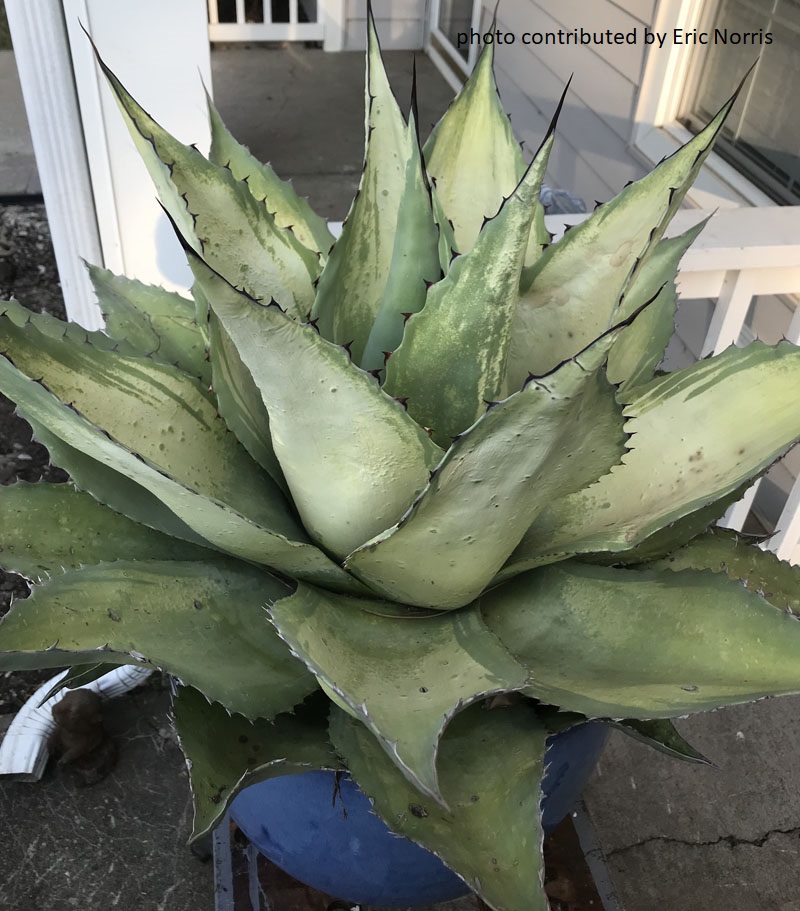
Speaking of Wizzie, this week on CTG she gives us the scoop on some new and very dramatic pest invaders. One of them is the agave snout weevil that’s destroying woody lilies. Thanks to Carlos E. Bogran, Texas AgriLife Extension Service, for this photograph.

I also want to thank gardener/blogger Pam Penick for providing images for this segment. Check out her blog, Digging, to see the weevil’s impact on her garden.

Another of the new arrivals that Wizzie documents is cycad scale. I thank Dave Palmer, UF/IFAS Extension for this image.

For all the rest of the “fun” news on insects, be sure to check out this week’s CTG. And, for ongoing updates and insider info on insects, including the good guys we love, visit Wizzie’s fabulous blog!

Wizzie identified this happy little family on my prickly pear, the first time I’ve seen this insect. This plant started from a pad that fell off or I pruned off my container cactus. It fell to the gravel “terrace” I made for container plants, and rooted.

It’s a cactus bug, a true bug in the family Coreidae. These guys are the nymphs, easier to control since they can’t fly away. But, she said it was just fine to leave them alone, since they don’t harm the plant, aside from the chlorotic spots. That works for me! If I wanted to get rid of them, she suggested insecticidal soap, neem, or horticultural oils (though caution in this heat if at all). But since they aren’t killers, why should I be? At this writing, they’re already gone. I have a very relaxed attitude about seasonal arrivals. I figure someone will eat them eventually.

The container prickly pear (which the bugs didn’t touch or just barely) is planted with mint, believe it or not. Years ago, someone gave me a start of mint from his garden, and for expediency, I just jammed it into that pot. They get along fine. Its big problem right now is hail damage.

Beyond, in the den bed, is Crinum ‘Ellen Bosanquet’ that bloomed this week.

Next to the prickly pear is a container of zinnias. I love zinnias but have a horrendous time with them in the ground. So I seed or transplant a few every summer in a container for the butterflies.

This week, along with butterflies, we got a hummingbird on them, too! Then he went to the turk’s cap along the patio, this flower flopping over the sambac jasmine. We held our breaths and stayed still. Once the hummers get used to us, maybe I can get a picture.

This zinnia is flopping over my container of basil, steps from the kitchen.

My patio containers include what I call my “stinky petunias.” These old- fashioned ones rival even the sambac for fragrance, for months on end. But I think these have been blooming almost non-stop for two years, since I haul them under the patio “greenhouse” in winter. I deadhead, but also let some go to seed, to start in new pots or revive old plantings when they give up.

Here they are against a pot of multi-colored, incredibly hot edible peppers I got at Zilker Garden Festival many years ago. Again, I protect them in winter, and at this point, it’s hard to tell if I have the original plant or just its seeded offspring.

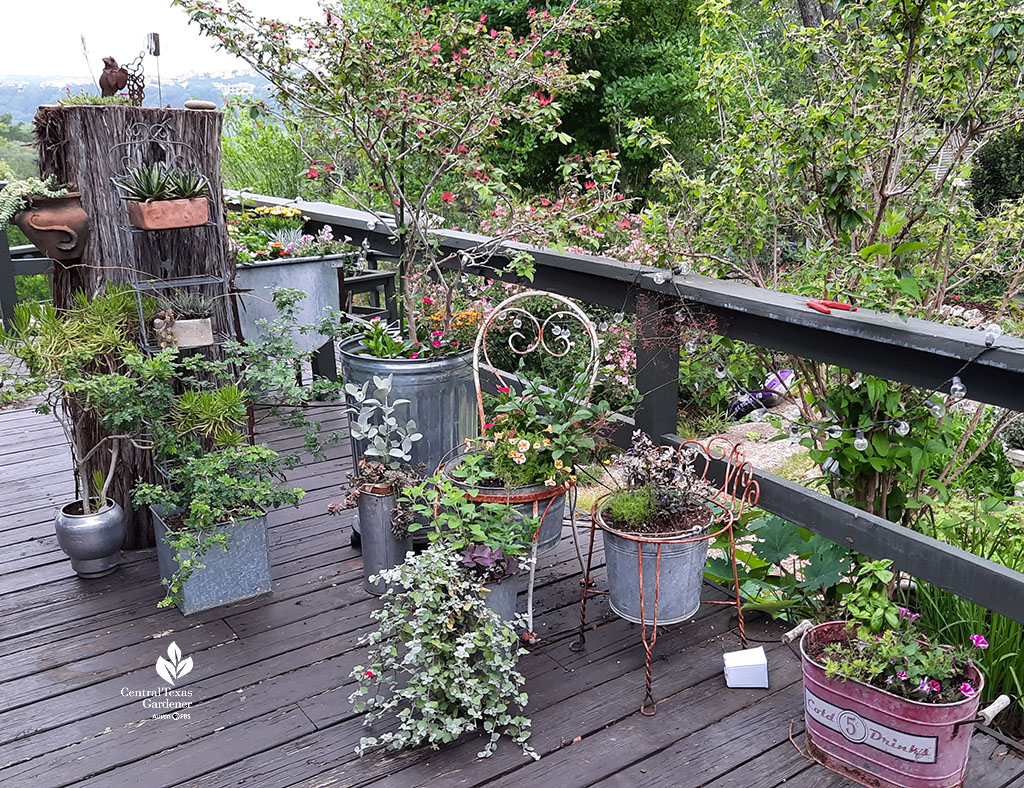
Since our patio is our second living room, it’s fun to have color, fragrance, and taste right up close, and with mulch on the pots, the water chores aren’t over the top.

Happy July 4th, and see ya next week, Linda

From the producer: June 28, 2008

June 26th, 2008 Posted in From the Producer | 8 Comments »

I must tell you that I’m thrilled with my experiment, Dicliptera suberecta. I was worried about the gray leaves in my clay (albeit composted) soil, but the folks at the nursery said it handled heavy wet just fine–in case it ever rains again. It’s filling out nicely in all the beds. This one in the crepe bed gets filtered sun with a few hot blasts during the day. It laughs at the heat!

Others get intense morning sun. I know that it can take cold, too, since I planted the first ones just days before we got our coldest freeze. It set them back a bit as new 4″ transplants, but not for long. One common name for it is hummingbird plant, a testament to its flowers. There were two on them last night!

The bouncing bet (Saponaria officinalis) in the crepe bed is blooming, too. I’ve had this one for years, through drought, drown, and freeze. It doesn’t get mad when you divide it, though I wouldn’t do it now.

What’s bizarre is that a few larkspurs are still blooming! These self-seeded guys are in the front room window, with purple heart (Setcresea) and fall asters beyond. By the way, a head’s up that all fall-only bloomers get their last clipping in the next two weeks.

My latest curiosity is ferns, thanks to Laura Joseph, our featured gardener, and our interview guest, horticulturist/designer Patrick Kirwin. Last fall we taped Laura’s gracious garden at her historic home. She’s now an internationally acclaimed fern expert, a plant passion that began in childhood. In containers and in the ground, she has magnificent specimens, from staghorns to natives to exotics I would never have recognized as ferns. But she doesn’t stop with ferns, and as a supreme plant experimenter, at every turn you run into surprises of color and texture. Laura’s also a long-term volunteer and garden club member at Zilker Botanical Garden. Recently she spearheaded The Garden Club of Austin’s new fern garden at Zilker to educate and entice novices like me.

Then, while shooting one of Patrick’s designs last spring, he spoke with passion about ferns, including the many natives that we can grow. That day, we came up with the idea for his segment with Tom, focusing mainly on native ferns, including ones for sun, and how to give them a creative design statement.

On that shoot with Patrick, it was actually an exotic, East India holly fern, that hooked me. When I literally ran into one at the nursery that weekend, I figured I’d take my first step into fern-ville. I got just one for the patio bed to see if our relationship was agreeable. So far, we’re still together!

For Patrick’s interview with Tom, I went to a nursery to borrow an Autumn fern, one on Patrick’s list, and ended up buying it. I planted it in the patio bed where the cycad used to live. It was over 100° when I planted it, but it didn’t care. Already I love it.

Patrick and Laura may have created a new fern fan, and with you, too, I hope. Patrick’s list will be on our web site. You can also click on John Dromgoole’s picture, for the list he recently presented as a fern lover.

As the heat goes on, I hope this week’s program will inspire you, as it did Tom and me, for a few new ideas. Until next week, Linda

From the producer: 6/21/08

June 19th, 2008 Posted in From the Producer | 6 Comments »

Today I feel like the “roving reporter.” This is what grass looks like when you cut it too short in marathon heat.

Mine is hanging in there, since we keep it tall, and let the clippings fall where they may, our free way to fertilize.

Over the years, I’ve whittled away the lawn by 70% or so, but some remains. Since I don’t give it special attention or any more water than the perennials, it’s the lowest maintenance part of my garden. And I really can’t handle any more plants right now! Hardscape or gravel paths come with their own set of duties, while the grass tidily absorbs leaf litter and seeds that fall its way. And you can’t beat it for playing ball with Chester the cocker spaniel!

With these record hot days, I’m glad for the Artemesia ‘Powis Castle’ and white plumbago in front. They make me feel cool just to see them. The plumbago will go into full swing in the next few months, when it’s a cloud of white, even in August. Since I moved the blues, they’re just coming on, but soon they’ll mingle with the white to refresh the most scalding of days.

The purple trailing lantana that frames this bed will soon join them in earnest. Beyond, the daylilies are upstaged for the moment, but they don’t mind, since they know they’ll get the starring role next spring.

In the beds leading to former photinia-ville, the Barbados cherry is ready to eat, though typically we sample one and leave the rest for the birds. This evergreen shrub/small tree tolerates drought and just about everything else.

Here are its flowers from a few months ago, free food for the bees.

Long ago, I planted a flame acanthus (Anisacanthus wrightii) in front of it for a double whammy of wildlife food. It flowers best in sun, but I’ve got some now in partial shade that are hanging in. It goes dormant in winter, and in February, I cut it to the ground. Springs back up in a minute. Very drought tolerant and I’ve never seen an unwelcome insect on it. I divided this one from one in back a few years ago and dug it up this spring to remove invasive ruellia from its rootball. Obviously that didn’t slow it down!

You can tell that it’s a flower designed for hummingbirds.

At one front street bed, the desert willow also invites the hummingbirds to join us. I saw the first one on it this week!

This week on CTG, I thank a viewer who introduced me to Martha’s Bloomers in Navasota. What a charming place!

Along with plants, mulch, and soil, they have a tearoom, antiques shop, pottery, gifts, and adopted pets, including Martha and Bloomer. I think this one is Martha. And I had nothing to do with this cat picture! Actually, I thank Sabrina Mayfield from Martha’s for sending them.

Gay Houston, a passionate plant person and clever designer, pulls together enticing combinations that include sedums and other drought-tolerant plants. The full list will be on our web site.

On tour, we visit Roxane Smith and Gary Aitcheson in a soothing, cooling garden they created with backbreaking work. They’re very busy right now, too, organizing a fabulous Garden Conservancy Open Days Tour for October 4, so mark your calendars!

Until next week, Linda

From the producer: 6/14/08

June 12th, 2008 Posted in From the Producer | 3 Comments »

Since the hot, dry days are upon us, I figured we needed a little perking up this week. In lieu of a good soaking rain (sadly out of my control) Sharon Truett from The Natural Gardener gives us a tour of drought tolerant plants for shade, including a few surprises! Sambac jasmine, one of her selections, has a bonus: you can make tea from its flowers. I’ve had this one in a patio container for many years.

sambac jasmine

Last winter I didn’t bring it under cover and it froze back, but rebounded nicely. Originally I got it as a gardenia substitute, since that beloved plant from my childhood cratered in two months when I planted it in Austin. I don’t miss gardenia at all since the sambac perfumes summer nicely, picking up where the star jasmine left off in spring. By the way, we’ll put Sharon’s plant list under John Dromgoole on our web site.

Marcus Young, talented designer and owner of Bloomers in Elgin, has us salivating again with the performers that wait around until hot weather. His foliar and flower combinations for containers or beds are so beautiful that they take the grit out of summer. His complete plant list will be online under This Week. We archive program details, so if you need a list down the line, just check out Past Shows.

On our garden visit, I think that Elayne Lansford will find a rich place in your heart, as she has in mine. Her story includes container tropicals, with passalongs and other “dear little friends” that she’s had for years, protected in husband-built greenhouses or improvised protection every winter. In addition, her widespread garden is a National Wildlife Federation backyard habitat. She’s available to meet with individuals or groups for help on starting a backyard habitat, so email me at ctg@klru.org if you’d like to be in touch.

And part of her story is how the garden evolved, giving her strength and healing, when she was diagnosed with cancer. I thank her friend Brende who recommended this inspiration for us all.

In my garden, the back fence is certainly a wildlife habitat, albeit a little out of control, with bird food sunflowers that re-seed every year. I need to thin them, since they’re shading out the wildlife nectaring perennials.

But these guys always come back, so you have to give them that. I’ve tried seeding all the glorious hybridized colors, but have never had any luck with them.

I wish the birds would eat the mealybugs that are having a field day this year. This brood is on the batface cuphea in the crepe bed. If they bother you, spray them with neem oil or dab them with rubbing alcohol. Usually, I just wait for them to go away on their own. I just don’t get too worried about insects. Like compost, insects happen, and I’ve never lost a plant to mealybugs. I do control them on container plants, like the Satsuma orange, but generally that’s with my fingers.

This crepe picture isn’t the best, though in person, it was great! I walked out one morning to see the pinks in action in the crepe bed: Knock Out rose and the coneflowers. The batface is out of view in this picture, but it was there to my wide eye view.

Two days before, a pavonia was in bloom between them.

pavonia in crepe bed

In front of them, a Salvia ‘Hotlips’ is putting on a few flowers but is too camera shy for the moment. So just imagine my little color scheme of pink and red dots in the bed. Really, I just moved everyone around this spring for more sun, and bingo, a “design” was born.

On the patio, the turks cap is starting to bloom, though so far, I haven’t seen a single hummingbird. The creek project and its noise may have frightened them off.

Beyond is the cat statue and cat ladder. Greg recently replaced a bad rung and I haven’t gotten around to painting it.

Even our elderly cat Spencer climbs the ladder now and then. In the heat, he stays mainly indoors, except for a brief after-dinner nap near the primrose jasmine beyond the ladder, in case he has a rare burst of 17-year-old energy.

Finally, my heartfelt condolences go out to Sharon Truett, whose beloved husband, Raymond Carlton, died of a heart attack last Sunday. When we were taping the studio segment a few weeks ago, Sharon confessed that she was a little nervous. I told her to talk to the camera as if it were Raymond. I’m sorry that he won’t see what a great job she did. Linda

From the producer: June 7, 2008

June 5th, 2008 Posted in From the Producer | 2 Comments »

I love life stories. In my little routine, it can be difficult to see progress, other than the outright obvious: got this week’s CTG on the air, the bulb foliage pruned down, Erlicheer bulbs moved while I could still see them, and the first coneflowers in the crepe bed bloomed!

Of course, I can see progress outside. Greg and I are astounded that what was bare ground a few months ago has filled in so well. We agree that the front looks a lot better, glorious even, in our view. But I wouldn’t wish last fall’s plumbing adventure on anyone.

Still, it was the incentive to dump nandina-ville and carve a beautiful new look. I have a few gaps to fill yet, and I’m thinking of the dwarf Abelia ‘Rose Creek’ or ‘Mardi Gras’ that Jeff from The Emerald Garden mentioned on CTG a few weeks ago.

And we don’t miss photinia-ville one bit; in fact, we wonder now why we didn’t do it sooner. The cenizo, thryallis, and moved rose are growing like weeds. I’m thinking about adding the orange version of esperanza (Tecoma stans) to the mix. Pictures of the front soon, it’s still too early for wide shots.

Achieving these small goals is great, but the really big picture of life is harder for me to grasp. I guess that’s why I’m such a fan of PBS programs like American Experience and American Masters. When I see someone’s timeline put into perspective, I find significance in that journey to insert into mine. It’s also one commitment I have for CTG; to share gardeners’ journeys with you.

This week’s guest, Jeannie Ralston, is another inspiration I’ve met in person. A New York journalist, she married National Geographic photographer Robb Kendrick. He wanted to return to country roots, and she wound up in Blanco. On a fluke, they started Hill Country Lavender, and unwittingly started a whole new industry for the Hill Country.

I met her years ago when we taped the lavender farm. Here’s Robb with our director, Ed Fuentes.

You can see our award-winning video on Jeannie’s site under Videos. We’ve stayed in touch as she and Robb moved on to other pursuits, leaving Hill Country Lavender in loving hands. Now, Jeannie’s published her first book, The Unlikely Lavender Queen: A Memoir of Unexpected Blossoming, detailing the unexpected confrontation that changed her life.

In her conversation with Tom, she also gives us hands-on tips for growing lavender at home. Lavender can be the Holy Grail for gardeners, who prize its foliage, fragrance, and herbal use (the flowers are a nice bonus), but that can suddenly go belly up between sniffs. I’m still quite astounded that the lavender I stuck in the cat cove last year survived all the rain. I guess it’s the crushed granite that did it.

To meet Jeannie yourself for more lavender tips, visit our calendar on our Blog page or at Events on our home page to scroll through her Texas appearances. You can also get the scoop on the Blanco Lavender Festival June 14 & 15. Grab a friend and a camera for a sensory good time.

Although my lavender isn’t blooming, the althea (Rose of Sharon) put on a nice display in the rental side bed. This is truly amazing since it’s way too shady for her, but I don’t dare try to move her. She’s almost the last of the ones that came with the house, old-fashioned deciduous shrubs that I love.

They mean summer to me.

In the crepe bed, the Mexican oreganos have started to bloom lavender. This is Poliomintha longiflora, not to be confused with Lippia Graveolens, since they have the same common name. This little evergreen woody perennial (about 2-1/2′ for me) accepts shade, attracts hummingbirds, butterflies, and bees, and can be used for cooking. In February, I give it the same tough pruning I give to the Salvia greggiis to encourage lush new growth. And that’s about it.

The plumbagos, in a hue of lavender, are starting to bloom, even the ones I recently moved in front. This guy is under the rental fence pistache, with a passalong shrimp plant beyond.

For another good read, a mystery that includes lots of wonderful tips about growing lavender, along with recipes and crafts, check out Susan Wittig Albert’s Lavender Lies. But to get the complete picture of her series, featuring real-world life changes through her fictional character, gardener China Bayles, start with Thyme of Death, the first in the series. It won’t be hard to keep on reading until you get to the current book, Nightshade.

You’ll also want to check out her web site and blog for the history of herbs, recipes, garden tips, her life as an author, and much more.

Susan doesn’t know it, but she was a life-changing event for me. A few years ago I went to hear her speak about how she exchanged her secure career to become a full-time writer. I’ve also watched her grow into international acclaim on her web site, as well as a recognized and beloved author, where readers simply can’t wait for the next book.

I thank her, Jeannie, our CTG guests and gardeners, and especially all of you, for a life’s progression that gets richer every day. And let me know how your lavender is doing! Linda